Taiwan’s net-zero push is turning into a race for AI-driven energy dominance
At the 2026 Smart City Summit & Expo and Net Zero City Expo, there are a couple of interesting presentation that delves deeper into how Taiwan's strive in enhancing its city and operations with AI comes with loads of challenges in terms of keeping its tech green. The first one is given by the Executive Vice Preside
At the 2026 Smart City Summit & Expo and Net Zero City Expo, there are a couple of interesting presentation that delves deeper into how Taiwan's strive in enhancing its city and operations with AI comes with loads of challenges in terms of keeping its tech green.
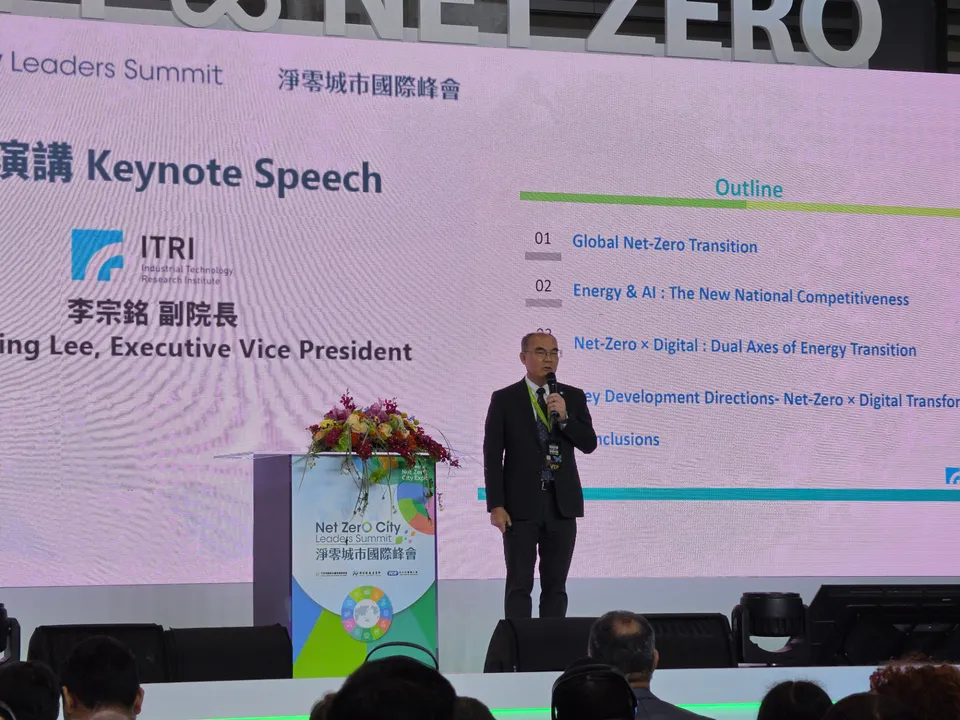
The first one is given by the Executive Vice President of Industrial Technology Research Institute, Tzong-Ming Lee.
Globally, momentum is accelerating, with net-zero pledges growing from 124 countries in 2020 to 139 by 2026, while regional governments and cities are ramping up even faster. At the same time, the roadmap is becoming clearer, with electrification, renewables overtaking fossil fuels, AI-driven efficiency, carbon capture, and smarter grids all forming the backbone of the transition.
Zooming into Taiwan, the timeline shows a steady build-up. The push started in 2016, before former President Tsai Ing-wen formalized the 2050 net-zero goal in 2021, followed by the official pathway and 12 strategies in 2022. Now in 2024, President Lai Ching-te is driving what’s called the "Second Energy Transition," which doubles down on both energy resilience and diversification.
What really stands out is the core idea behind it - electricity is computing power, and computing power is national power. That’s shaping a dual-track strategy where Taiwan is expanding green energy sources like wind, solar, geothermal, hydrogen, and more, while also pushing deep energy efficiency through smarter systems, AI-driven management, and high-efficiency data centers.
This is where the “Net-Zero x Digital” concept comes in. It’s about combining sustainability - like renewables, storage, and carbon reduction - with digital intelligence using AI, IoT, and data analytics to make energy systems more efficient and predictable.
On the tech side, the roadmap spans everything from smart grids and net-zero buildings to CCUS and hydrogen. The Industrial Technology Research Institute (ITRI) is already working on solutions like high-efficiency solar cells, rare-earth-free motors, low-carbon cooling systems, and AI-powered energy monitoring, alongside advanced data center cooling technologies that can cut energy use by up to 40%.
Hydrogen and carbon capture are also key pillars, with innovations in green hydrogen production, ammonia conversion, and CO2 reuse through partnerships with companies like Chimei Corporation and Mitsubishi Electric. At the same time, circular carbon solutions and AI-driven materials are helping reduce emissions even further.
The strategy also extends to virtual power plants and microgrids, where AI and IoT are used to dynamically manage energy demand and improve grid stability, turning systems like refrigeration into energy-saving assets.
The 2nd part of the speech sticks with the same topic, albeit at a global scale, featuring other countries as examples, delivered by Programme Director Giorgia Rambelli.
She started off by referencing the stark reality that cities account for nearly three-quarters of global energy consumption and about 70% of greenhouse gas emissions, which means if cities don’t move fast, net-zero simply doesn’t happen.
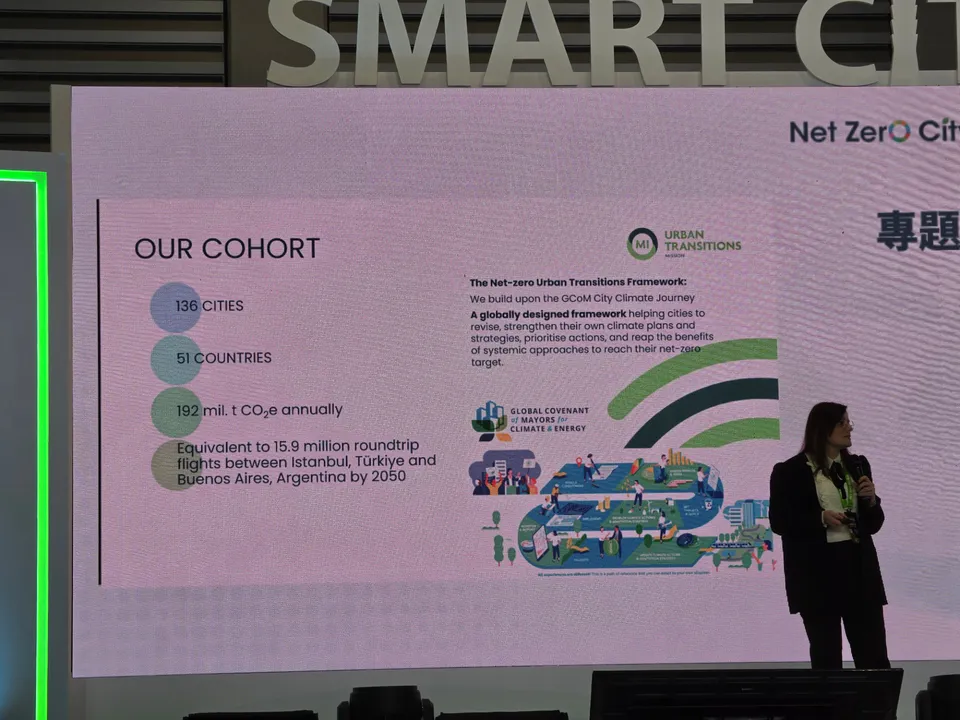
That’s where initiatives like the Urban Transitions Mission under Mission Innovation come in. Backed by 23 countries and the European Commission, the program is essentially trying to accelerate clean energy adoption through digital solutions and AI, while bringing together governments, industries, and cities to push large-scale change. Right now, the cohort already spans 136 cities across 51 countries, collectively targeting 192 million tons of CO2 equivalent reductions annually, which gives you a sense of the scale they’re aiming for.
What’s interesting is how cities are prioritizing their efforts. Renewable energy leads the list, followed closely by urban mobility, water and waste systems, energy efficiency, land use, and urban regeneration - so it’s not just about energy grids, but the entire urban ecosystem.
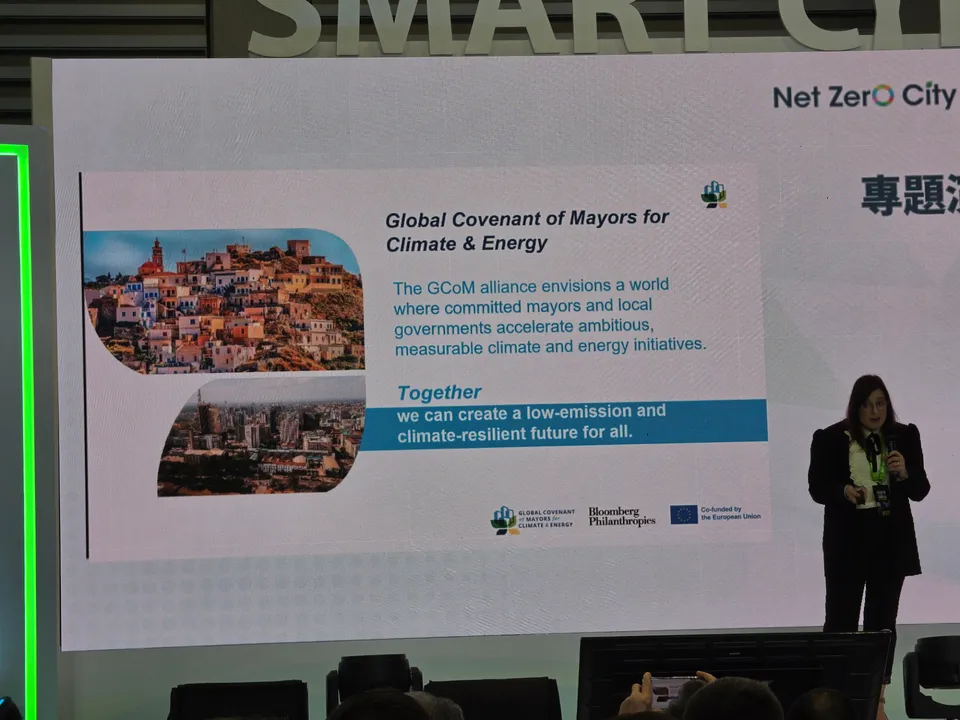
The broader support network is just as massive. The Global Covenant of Mayors for Climate & Energy alone represents over 13,800 cities and local governments, covering more than a billion people worldwide and contributing a potential 6.1 gigatons of CO2 reduction annually by 2050, which shows how local governments are becoming a major force in global climate action.
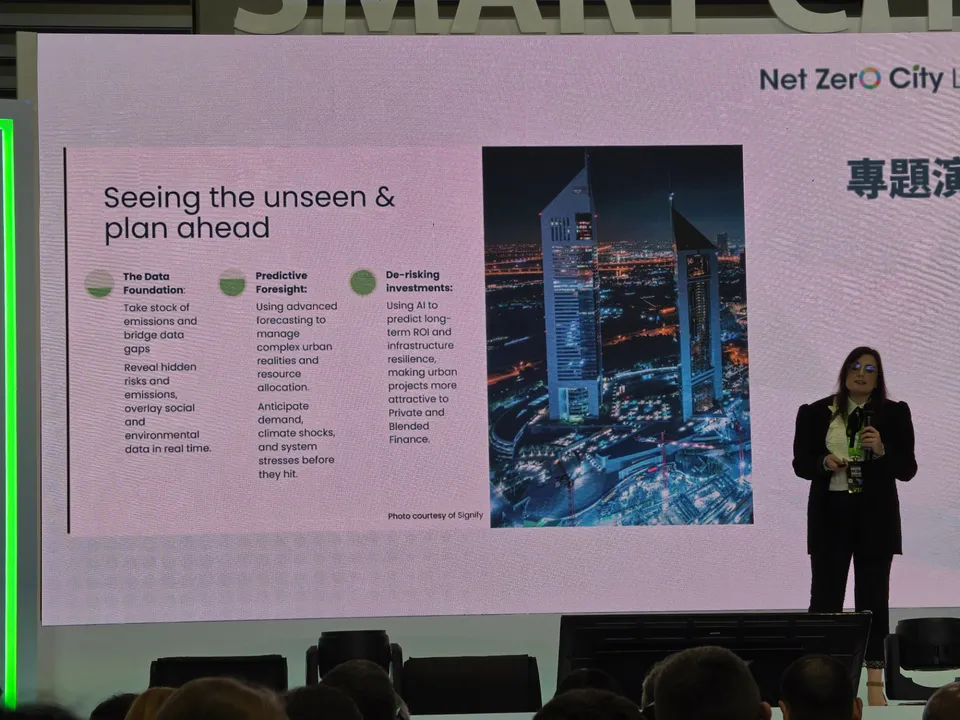
And here's where AI really starts to stand out, as cities are being encouraged to build strong data foundations first - tracking emissions in real time, filling data gaps, and identifying hidden risks - before moving into predictive tools that can forecast demand, anticipate disruptions, and even simulate the impact of policies before they’re implemented.
There’s also a big focus on making projects financially viable, using AI to de-risk investments by predicting returns and infrastructure resilience, which helps attract private funding. At the same time, digital twins are being used to simulate entire urban systems - from transport to energy to water - allowing cities to test decisions in virtual environments before rolling them out in the real world.
Another key idea here is “integrated infrastructure,” where everything is connected - transport, buildings, energy, and even natural systems - instead of being managed in isolation. Combined with electrification, renewable expansion, and smarter retrofitting, cities are essentially being redesigned as interconnected, responsive systems that can adapt in real time.
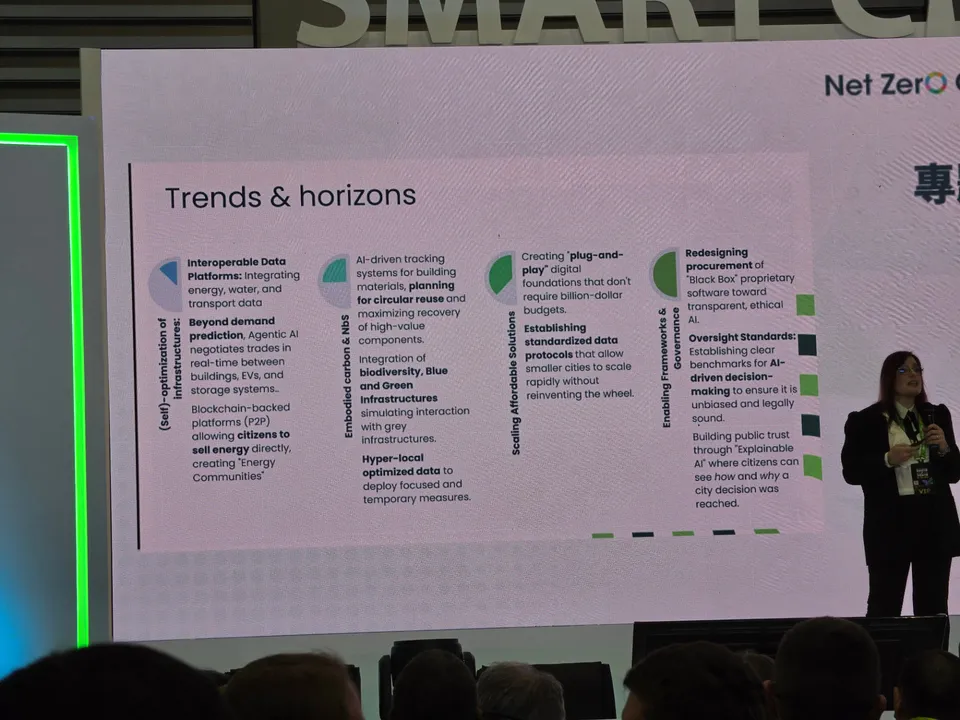
Looking ahead, the roadmap gets even more ambitious. We’re talking about interoperable data platforms that connect energy, water, and transport systems, AI agents handling real-time energy trading, and blockchain-backed peer-to-peer energy networks. On top of that, there’s a growing focus on embodied carbon and nature-based solutions, where AI helps track materials for reuse and integrates biodiversity into urban planning.
And then there’s the push to make all of this scalable, especially for smaller cities. The idea is to create plug-and-play digital systems and standardized data frameworks so that advanced solutions aren’t limited to major global hubs.
The case studies really bring all of this to life. In Greater Manchester, an AI-powered digital twin is being used to simulate energy use and guide fair, data-driven retrofits, while Rio de Janeiro is using AI and its operations center to monitor traffic and climate risks in real time, improving both transport efficiency and disaster response. Over in Varanasi, high-resolution mapping and AI simulations are helping preserve heritage sites and predict flood-related erosion, whereas Munich is applying digital twin models to tackle urban heat and optimize infrastructure.
Meanwhile, Barranquilla is taking a slightly different approach, using satellite data and AI to map informal settlements, plan flood-resilient "sponge city" designs, and identify biodiversity risks.
Google is adding shopping-focused responses to Gemini in Singapore, including product listings, review summaries, comparison tables, pricing and stock checks.
ASUS is positioning Agent Computer systems around local, hybrid and cloud AI, with ROG NUC and Ascent GX10 hardware supporting private, always-on agent workflows.
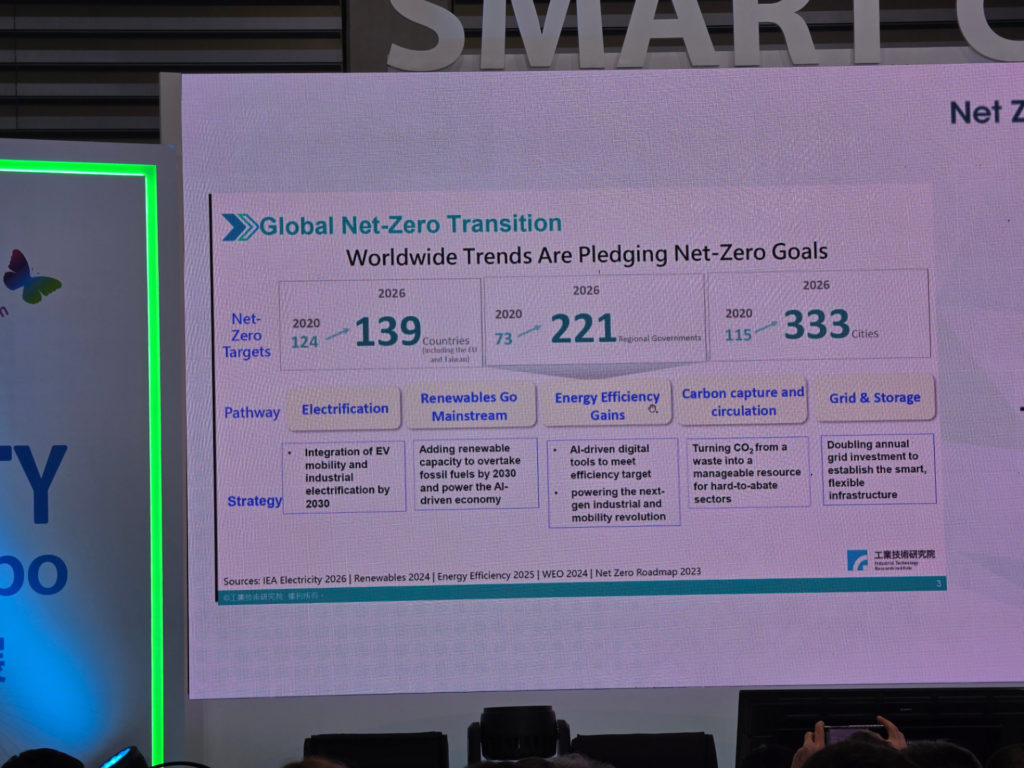 Globally, momentum is accelerating, with net-zero pledges growing from 124 countries in 2020 to 139 by 2026, while regional governments and cities are ramping up even faster. At the same time, the roadmap is becoming clearer, with electrification, renewables overtaking fossil fuels, AI-driven efficiency, carbon capture, and smarter grids all forming the backbone of the transition.
Zooming into Taiwan, the timeline shows a steady build-up. The push started in 2016, before former President Tsai Ing-wen formalized the 2050 net-zero goal in 2021, followed by the official pathway and 12 strategies in 2022. Now in 2024, President Lai Ching-te is driving what’s called the "Second Energy Transition," which doubles down on both energy resilience and diversification.
Globally, momentum is accelerating, with net-zero pledges growing from 124 countries in 2020 to 139 by 2026, while regional governments and cities are ramping up even faster. At the same time, the roadmap is becoming clearer, with electrification, renewables overtaking fossil fuels, AI-driven efficiency, carbon capture, and smarter grids all forming the backbone of the transition.
Zooming into Taiwan, the timeline shows a steady build-up. The push started in 2016, before former President Tsai Ing-wen formalized the 2050 net-zero goal in 2021, followed by the official pathway and 12 strategies in 2022. Now in 2024, President Lai Ching-te is driving what’s called the "Second Energy Transition," which doubles down on both energy resilience and diversification.
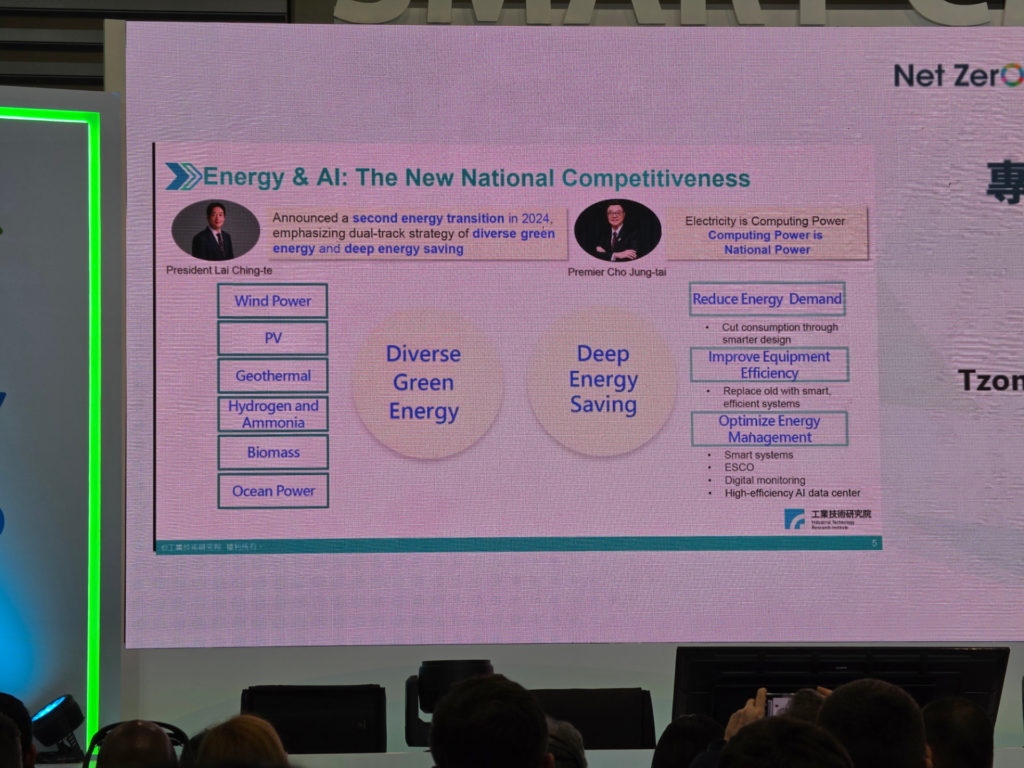 What really stands out is the core idea behind it - electricity is computing power, and computing power is national power. That’s shaping a dual-track strategy where Taiwan is expanding green energy sources like wind, solar, geothermal, hydrogen, and more, while also pushing deep energy efficiency through smarter systems, AI-driven management, and high-efficiency data centers.
This is where the “Net-Zero x Digital” concept comes in. It’s about combining sustainability - like renewables, storage, and carbon reduction - with digital intelligence using AI, IoT, and data analytics to make energy systems more efficient and predictable.
What really stands out is the core idea behind it - electricity is computing power, and computing power is national power. That’s shaping a dual-track strategy where Taiwan is expanding green energy sources like wind, solar, geothermal, hydrogen, and more, while also pushing deep energy efficiency through smarter systems, AI-driven management, and high-efficiency data centers.
This is where the “Net-Zero x Digital” concept comes in. It’s about combining sustainability - like renewables, storage, and carbon reduction - with digital intelligence using AI, IoT, and data analytics to make energy systems more efficient and predictable.
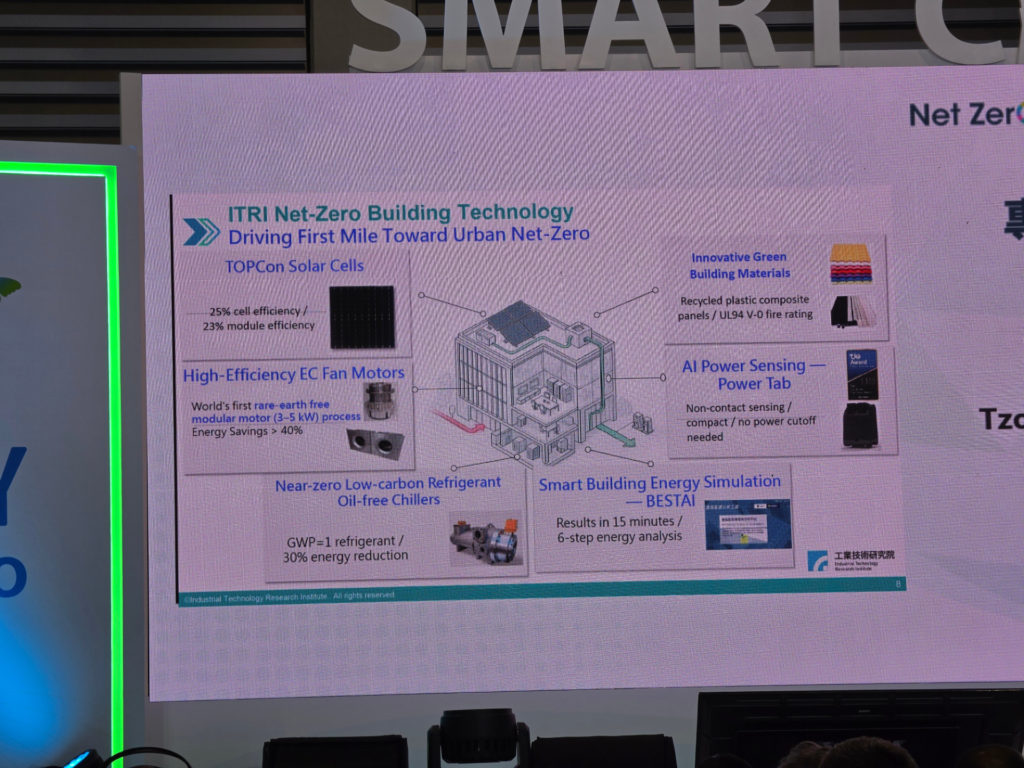 On the tech side, the roadmap spans everything from smart grids and net-zero buildings to CCUS and hydrogen. The Industrial Technology Research Institute (ITRI) is already working on solutions like high-efficiency solar cells, rare-earth-free motors, low-carbon cooling systems, and AI-powered energy monitoring, alongside advanced data center cooling technologies that can cut energy use by up to 40%.
Hydrogen and carbon capture are also key pillars, with innovations in green hydrogen production, ammonia conversion, and CO2 reuse through partnerships with companies like Chimei Corporation and Mitsubishi Electric. At the same time, circular carbon solutions and AI-driven materials are helping reduce emissions even further.
On the tech side, the roadmap spans everything from smart grids and net-zero buildings to CCUS and hydrogen. The Industrial Technology Research Institute (ITRI) is already working on solutions like high-efficiency solar cells, rare-earth-free motors, low-carbon cooling systems, and AI-powered energy monitoring, alongside advanced data center cooling technologies that can cut energy use by up to 40%.
Hydrogen and carbon capture are also key pillars, with innovations in green hydrogen production, ammonia conversion, and CO2 reuse through partnerships with companies like Chimei Corporation and Mitsubishi Electric. At the same time, circular carbon solutions and AI-driven materials are helping reduce emissions even further.
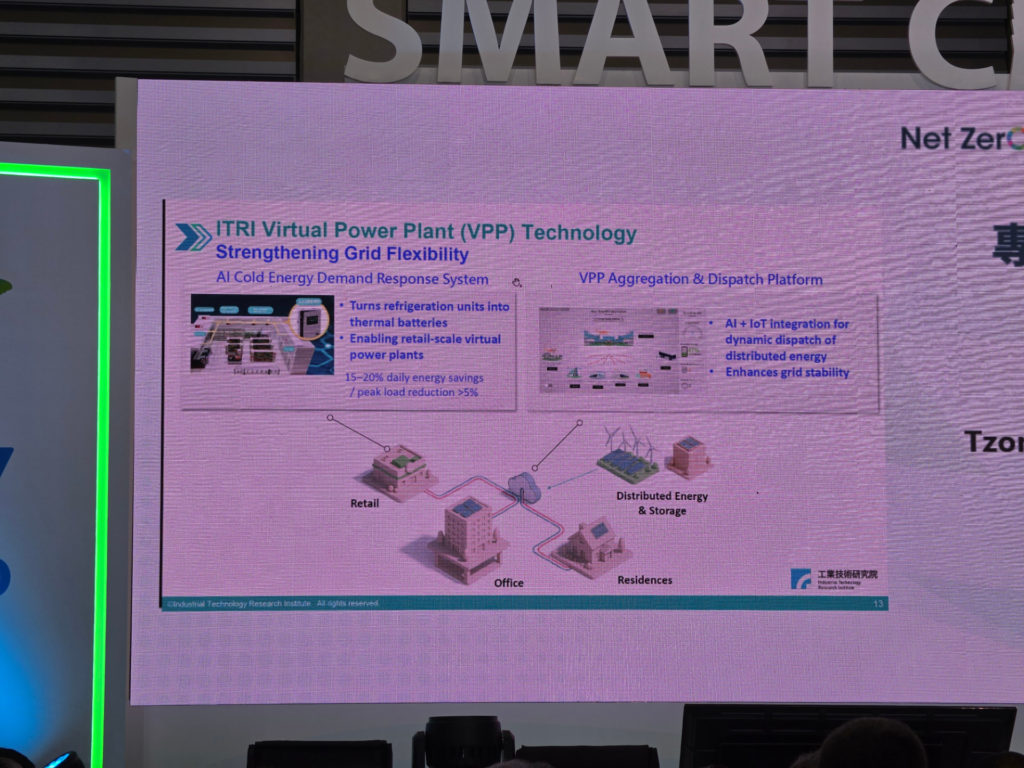 The strategy also extends to virtual power plants and microgrids, where AI and IoT are used to dynamically manage energy demand and improve grid stability, turning systems like refrigeration into energy-saving assets.
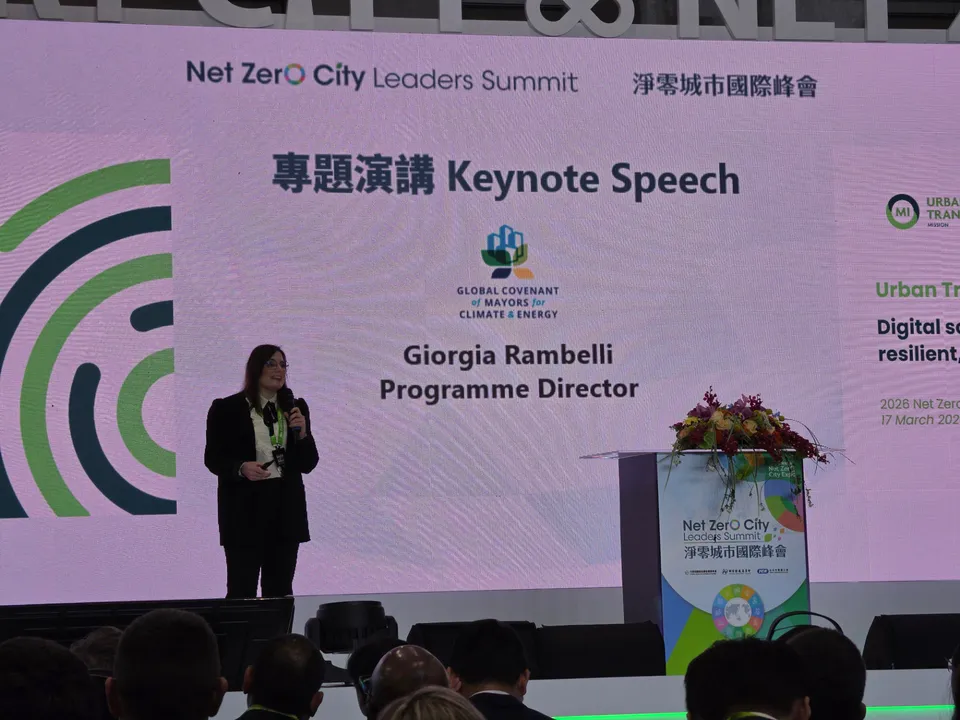 The 2nd part of the speech sticks with the same topic, albeit at a global scale, featuring other countries as examples, delivered by Programme Director Giorgia Rambelli.
She started off by referencing the stark reality that cities account for nearly three-quarters of global energy consumption and about 70% of greenhouse gas emissions, which means if cities don’t move fast, net-zero simply doesn’t happen.
The 2nd part of the speech sticks with the same topic, albeit at a global scale, featuring other countries as examples, delivered by Programme Director Giorgia Rambelli.
She started off by referencing the stark reality that cities account for nearly three-quarters of global energy consumption and about 70% of greenhouse gas emissions, which means if cities don’t move fast, net-zero simply doesn’t happen.
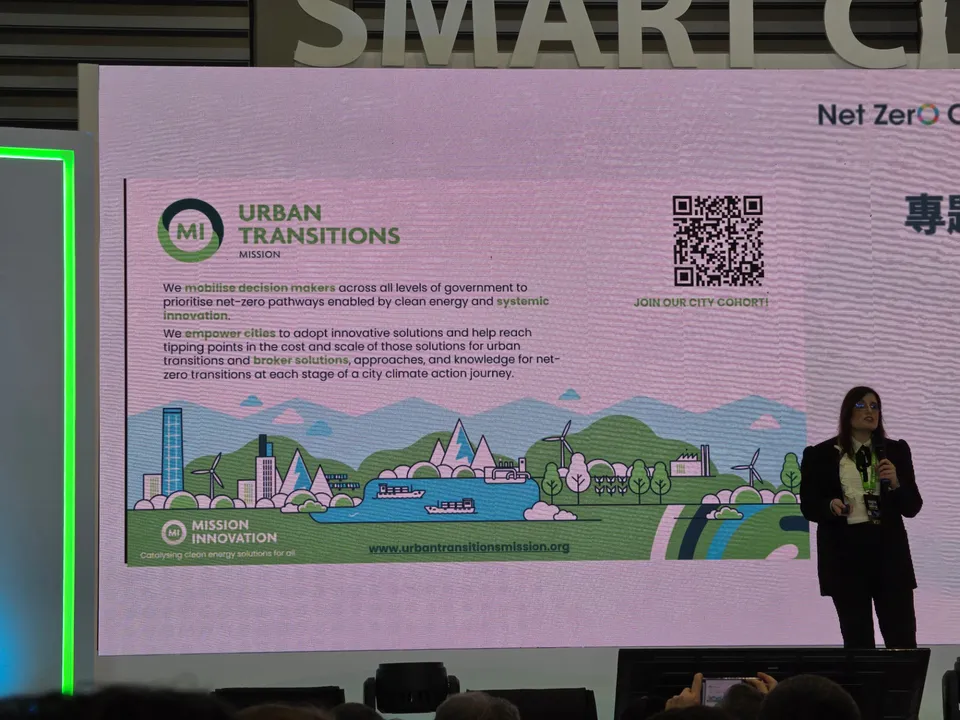 That’s where initiatives like the Urban Transitions Mission under Mission Innovation come in. Backed by 23 countries and the European Commission, the program is essentially trying to accelerate clean energy adoption through digital solutions and AI, while bringing together governments, industries, and cities to push large-scale change. Right now, the cohort already spans 136 cities across 51 countries, collectively targeting 192 million tons of CO2 equivalent reductions annually, which gives you a sense of the scale they’re aiming for.
What’s interesting is how cities are prioritizing their efforts. Renewable energy leads the list, followed closely by urban mobility, water and waste systems, energy efficiency, land use, and urban regeneration - so it’s not just about energy grids, but the entire urban ecosystem.
That’s where initiatives like the Urban Transitions Mission under Mission Innovation come in. Backed by 23 countries and the European Commission, the program is essentially trying to accelerate clean energy adoption through digital solutions and AI, while bringing together governments, industries, and cities to push large-scale change. Right now, the cohort already spans 136 cities across 51 countries, collectively targeting 192 million tons of CO2 equivalent reductions annually, which gives you a sense of the scale they’re aiming for.
What’s interesting is how cities are prioritizing their efforts. Renewable energy leads the list, followed closely by urban mobility, water and waste systems, energy efficiency, land use, and urban regeneration - so it’s not just about energy grids, but the entire urban ecosystem.
 The broader support network is just as massive. The Global Covenant of Mayors for Climate & Energy alone represents over 13,800 cities and local governments, covering more than a billion people worldwide and contributing a potential 6.1 gigatons of CO2 reduction annually by 2050, which shows how local governments are becoming a major force in global climate action.
And here's where AI really starts to stand out, as cities are being encouraged to build strong data foundations first - tracking emissions in real time, filling data gaps, and identifying hidden risks - before moving into predictive tools that can forecast demand, anticipate disruptions, and even simulate the impact of policies before they’re implemented.
The broader support network is just as massive. The Global Covenant of Mayors for Climate & Energy alone represents over 13,800 cities and local governments, covering more than a billion people worldwide and contributing a potential 6.1 gigatons of CO2 reduction annually by 2050, which shows how local governments are becoming a major force in global climate action.
And here's where AI really starts to stand out, as cities are being encouraged to build strong data foundations first - tracking emissions in real time, filling data gaps, and identifying hidden risks - before moving into predictive tools that can forecast demand, anticipate disruptions, and even simulate the impact of policies before they’re implemented.
 There’s also a big focus on making projects financially viable, using AI to de-risk investments by predicting returns and infrastructure resilience, which helps attract private funding. At the same time, digital twins are being used to simulate entire urban systems - from transport to energy to water - allowing cities to test decisions in virtual environments before rolling them out in the real world.
Another key idea here is “integrated infrastructure,” where everything is connected - transport, buildings, energy, and even natural systems - instead of being managed in isolation. Combined with electrification, renewable expansion, and smarter retrofitting, cities are essentially being redesigned as interconnected, responsive systems that can adapt in real time.
There’s also a big focus on making projects financially viable, using AI to de-risk investments by predicting returns and infrastructure resilience, which helps attract private funding. At the same time, digital twins are being used to simulate entire urban systems - from transport to energy to water - allowing cities to test decisions in virtual environments before rolling them out in the real world.
Another key idea here is “integrated infrastructure,” where everything is connected - transport, buildings, energy, and even natural systems - instead of being managed in isolation. Combined with electrification, renewable expansion, and smarter retrofitting, cities are essentially being redesigned as interconnected, responsive systems that can adapt in real time.
 Looking ahead, the roadmap gets even more ambitious. We’re talking about interoperable data platforms that connect energy, water, and transport systems, AI agents handling real-time energy trading, and blockchain-backed peer-to-peer energy networks. On top of that, there’s a growing focus on embodied carbon and nature-based solutions, where AI helps track materials for reuse and integrates biodiversity into urban planning.
And then there’s the push to make all of this scalable, especially for smaller cities. The idea is to create plug-and-play digital systems and standardized data frameworks so that advanced solutions aren’t limited to major global hubs.
Looking ahead, the roadmap gets even more ambitious. We’re talking about interoperable data platforms that connect energy, water, and transport systems, AI agents handling real-time energy trading, and blockchain-backed peer-to-peer energy networks. On top of that, there’s a growing focus on embodied carbon and nature-based solutions, where AI helps track materials for reuse and integrates biodiversity into urban planning.
And then there’s the push to make all of this scalable, especially for smaller cities. The idea is to create plug-and-play digital systems and standardized data frameworks so that advanced solutions aren’t limited to major global hubs.
 The case studies really bring all of this to life. In Greater Manchester, an AI-powered digital twin is being used to simulate energy use and guide fair, data-driven retrofits, while Rio de Janeiro is using AI and its operations center to monitor traffic and climate risks in real time, improving both transport efficiency and disaster response. Over in Varanasi, high-resolution mapping and AI simulations are helping preserve heritage sites and predict flood-related erosion, whereas Munich is applying digital twin models to tackle urban heat and optimize infrastructure.
Meanwhile, Barranquilla is taking a slightly different approach, using satellite data and AI to map informal settlements, plan flood-resilient "sponge city" designs, and identify biodiversity risks.
The case studies really bring all of this to life. In Greater Manchester, an AI-powered digital twin is being used to simulate energy use and guide fair, data-driven retrofits, while Rio de Janeiro is using AI and its operations center to monitor traffic and climate risks in real time, improving both transport efficiency and disaster response. Over in Varanasi, high-resolution mapping and AI simulations are helping preserve heritage sites and predict flood-related erosion, whereas Munich is applying digital twin models to tackle urban heat and optimize infrastructure.
Meanwhile, Barranquilla is taking a slightly different approach, using satellite data and AI to map informal settlements, plan flood-resilient "sponge city" designs, and identify biodiversity risks.