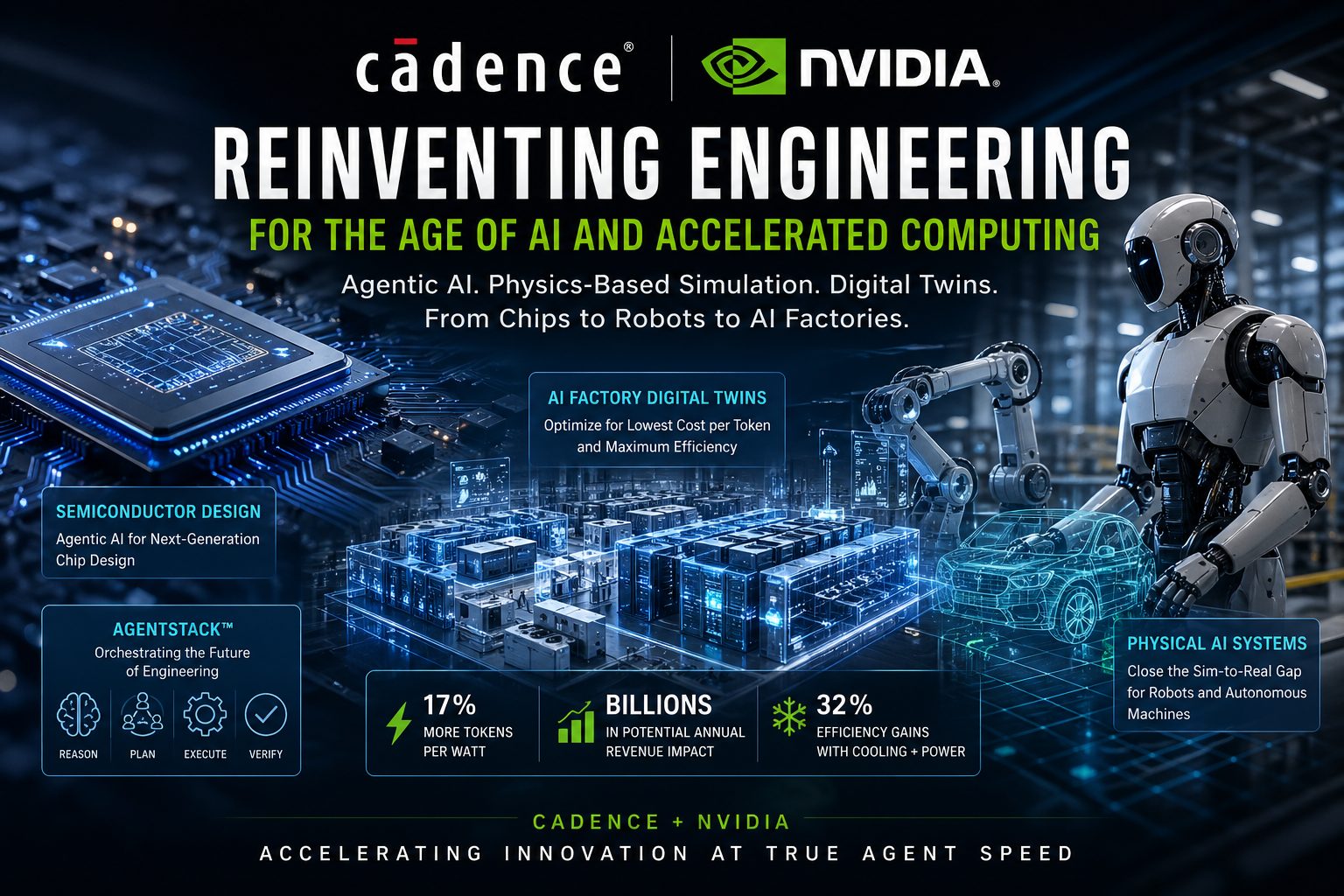
In a move that signals where the future of engineering is headed, Cadence and NVIDIA have announced an expanded partnership that goes far beyond traditional semiconductor design. The collaboration, unveiled at CadenceLIVE Silicon Valley 2026, brings together agentic AI, physics-based simulation, and digital twin technologies to fundamentally reshape how modern engineering is done.
If you think this is just another “AI partnership” headline - it’s not. This is a clear step toward fully autonomous, AI-orchestrated engineering workflows.
From Tools to “Agents”: Engineering at Machine Speed
At the core of this collaboration is a shift from human-driven workflows to agent-driven systems. Cadence’s newly introduced AgentStack™ builds on its ChipStack AI Super Agent, aiming to orchestrate everything from chip design to system-level engineering.
The idea is simple, but powerful:
Instead of engineers manually iterating designs, AI agents can now reason across entire systems - RTL, physical design, analog, and even full system simulations - reducing iteration cycles from days to hours.
NVIDIA isn’t just a partner here - it’s also an early adopter. By feeding real-world design feedback into AgentStack, NVIDIA is effectively helping shape the next generation of engineering workflows.
100X Simulation Speedups? That’s Not a Typo
One of the most striking claims from the announcement is the potential 100X acceleration in engineering workflows.
This comes from combining:
- Cadence’s EDA and SDA platforms
- NVIDIA CUDA-X and AI physics models
- The Cadence Millennium™ M2000 supercomputing platform
Together, these allow engineers to simulate complex systems — from chips to data centres — at unprecedented speed and scale.
And this isn’t theoretical. Early adopters including Samsung, SK Hynix, and Honda R&D are already leveraging these accelerated solutions to bring products to market faster.
Bridging the “Sim-to-Real” Gap in Robotics
Beyond semiconductors, the partnership dives deep into physical AI systems - think robotics, autonomous machines, and edge AI.
By integrating Cadence’s physics simulation with NVIDIA’s Isaac robotics platform, the companies are tackling one of the hardest problems in AI:
How do you ensure what works in simulation actually works in the real world?
The answer lies in a tightly integrated loop:
- Train in simulation (Isaac Sim, Isaac Lab)
- Validate with high-fidelity physics models
- Deploy on real hardware (Jetson)
- Continuously refine via digital twins
This closes the loop between simulation and deployment - something the industry has struggled with for years.
AI Factories: Optimising for “Tokens per Watt”
Perhaps the most forward-looking part of the collaboration is around AI factory digital twins.
As hyperscale AI infrastructure grows, a new metric is emerging: Tokens per watt - how efficiently AI models can process data per unit of power.
Using NVIDIA Omniverse and Cadence simulation tools, companies can now model entire AI data centres before building them.
The results?
- Up to 17% more tokens per watt from power optimisation
- Potential billions in additional annual revenue at scale
- Up to 32% efficiency gains when combining cooling and power strategies
This is where simulation stops being a design tool - and becomes a business optimisation engine.
The Bigger Picture
What Cadence and NVIDIA are building isn’t just faster tools - it’s a new paradigm:
- Engineering workflows run by AI agents
- Entire systems designed as digital twins first
- Continuous feedback between simulation and reality
- Infrastructure optimised before it even exists
As NVIDIA CEO Jensen Huang puts it, we are now at a point where we can “build everything as full-fidelity digital twins first.”
Our Thoughts
This partnership is a glimpse into what the next decade of engineering will look like. For companies in semiconductors, robotics, or even large-scale infrastructure, the message is clear: If you’re not designing with AI and simulation at the core, you’re already behind.
And for the broader tech ecosystem, from SaaS to industrial systems, this is another signal that AI isn’t just augmenting workflows anymore. It’s starting to run them.
The age of agent-driven engineering has officially begun.
Source: https://www.cadence.com/en_US/home/company/newsroom/press-releases/pr/2026/cadence-and-nvidia-expand-partnership-to-reinvent-engineering.html