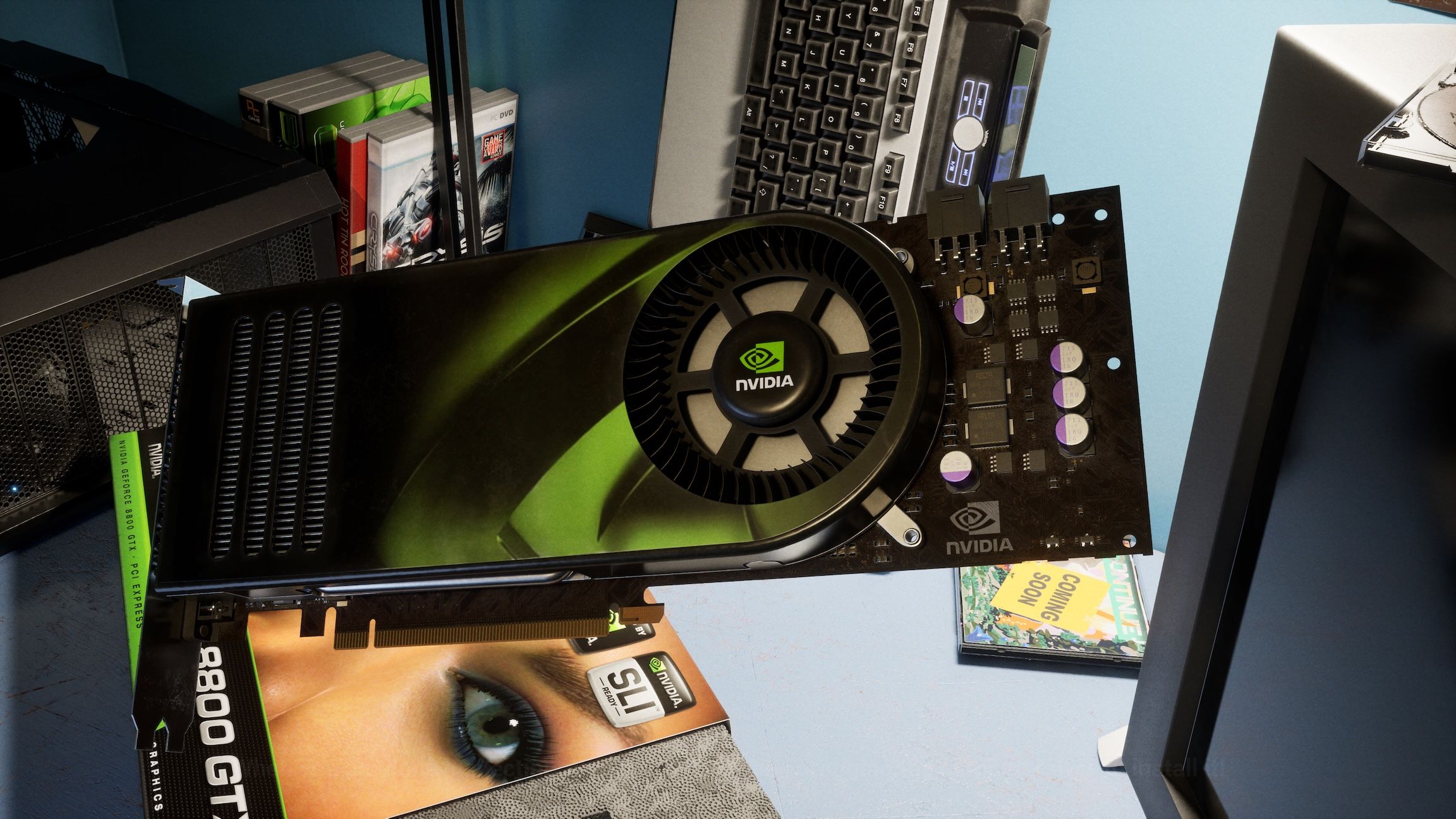
NVIDIA is marking 20 years since the GeForce 8800 GTX with a free, semi-interactive Steam demo that rebuilds a 2006 gaming room using current RTX rendering technology.
GeForce 8800 GTX — 20 Years of a Legend was created by Unreal Engine artist Dylan Browne with support from NVIDIA. Rather than reproducing a period game, the experience focuses on the ritual around a major PC upgrade: opening the box, examining the card, fitting it into a period-appropriate desktop and exploring the room for references to GeForce history.
A virtual trip back to the G80 era
The original GeForce 8800 GTX reached shops on 8 November 2006. Built around NVIDIA's G80 architecture, it introduced a unified shader design with 128 stream processors, replacing the more rigid separation between pixel and vertex hardware used by earlier generations. It also supported DirectX 10 and paired 768MB of GDDR3 memory with a 384-bit memory interface.
Those specifications put the card at the centre of a particularly demanding period for PC graphics. NVIDIA highlights Company of Heroes, BioShock and Crysis among the games associated with the era. The last of those also helped popularise the long-running “But can it run Crysis?” shorthand for hardware performance.
The anniversary demo fills its virtual room with details from that period. NVIDIA says players can find hardware including the TNT2, GeForce 2, GeForce 6800 Ultra and nForce 680i motherboard, alongside the 8800 GTX and its original box artwork. Posters reference classic NVIDIA technology demonstrations such as Froggy, Cascades and Adrianne, while Windows Vista's startup sound completes the period setting.
Rendered with modern RTX technology
Although its subject is firmly rooted in 2006, the room is rendered with technology from NVIDIA's current graphics stack. The company lists path tracing, DLSS 4.5 Ray Reconstruction, Dynamic Multi Frame Generation and RTX Mega Geometry among the features used to produce the scene.
The result is an intentionally sharp contrast: a CRT-lit room, old PC hardware and a boxed 8800 GTX presented through rendering techniques that arrived many hardware generations later. NVIDIA describes the download as a semi-interactive demo rather than a conventional game, so prospective users should expect a compact nostalgic showcase built around inspection and discovery.
The Steam listing targets GeForce RTX and RTX Spark systems. NVIDIA also says Game Ready Driver 621.14 or newer is required. The experience is free to download on Steam and is scheduled to come to GeForce NOW for Ultimate members, although NVIDIA has not given a date for the cloud release.
The 8800 GTX's link to CUDA
The anniversary also gives NVIDIA an opportunity to revisit the card's significance beyond games. The GeForce 8800 GTX was the first CUDA-capable graphics card, giving developers a route to use the GPU's parallel processing resources for work outside conventional graphics rendering.
That shift did not turn the 8800 GTX into today's AI accelerator overnight, but it established an important hardware and software foundation. CUDA let developers divide suitable computational problems into many smaller tasks for parallel execution on the GPU. Scientific computing, simulation and video processing were among the early applications, while the platform later became central to NVIDIA's role in modern AI infrastructure.
Seen from 2026, the 8800 GTX therefore occupies two connected places in NVIDIA's history: it was a high-end gaming card associated with the transition to DirectX 10 and unified shaders, and it was the consumer GPU that helped begin the company's CUDA era.
Where to find the anniversary demo
GeForce 8800 GTX — 20 Years of a Legend is available as a free download from Steam. NVIDIA has also published a trailer on YouTube and a longer anniversary retrospective covering the card's specifications, games and CUDA legacy.