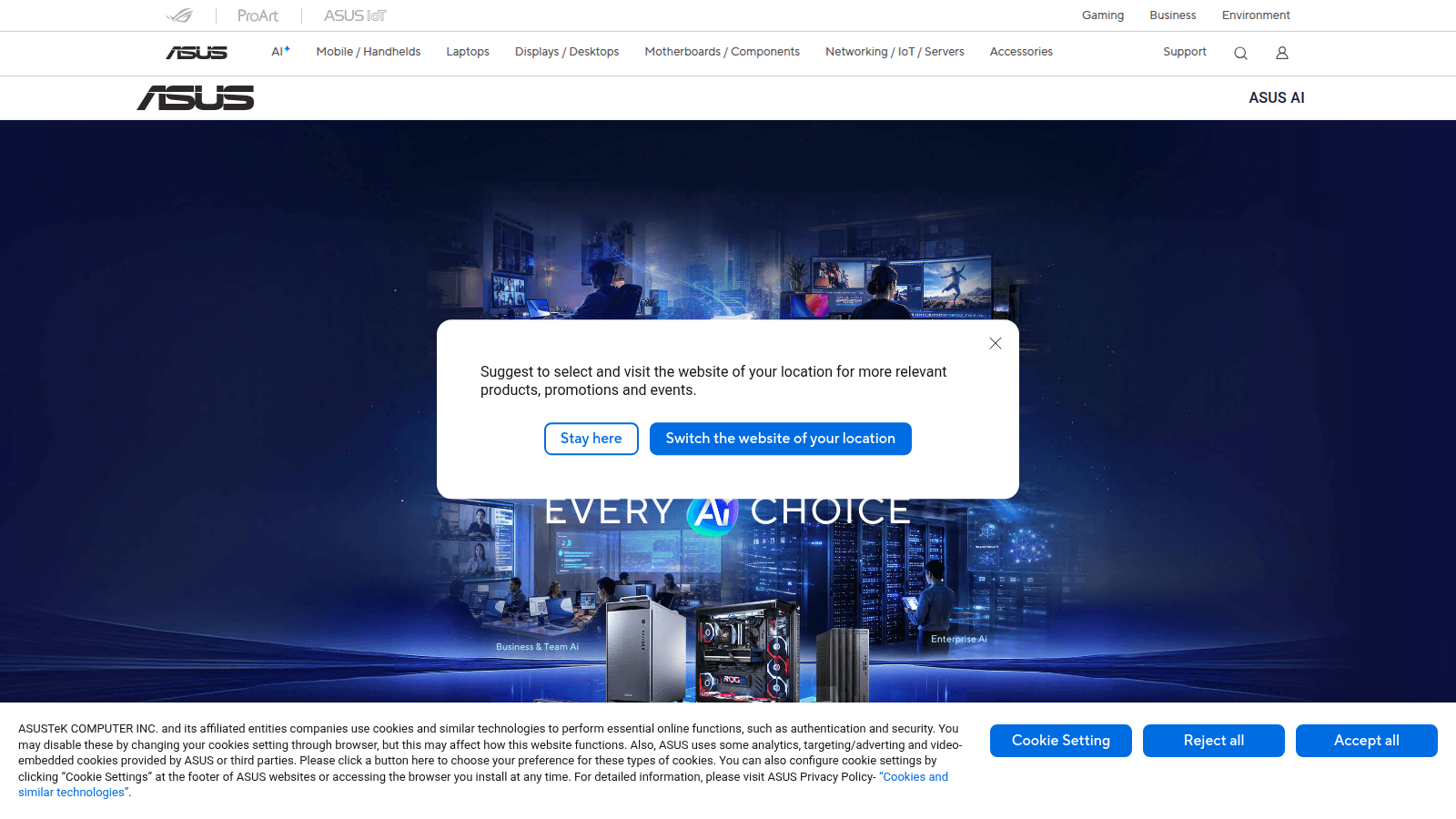
ASUS is using the term Agent Computer for an ecosystem that spans local, hybrid and cloud AI workloads. The company’s pitch is that organisations and advanced users should be able to choose where models run according to performance, privacy, cost and deployment requirements instead of sending every task to a hosted service.
The concept covers hardware for continuously running AI agents, local small-language-model processing, private retrieval-augmented generation and shared AI services. ASUS also presents local execution as one way to reduce dependence on metered cloud API usage, although the actual saving will depend on the model, workload, hardware utilisation and electricity costs.
Local processing is one part of a hybrid strategy
ASUS does not frame the Agent Computer as a universal replacement for cloud AI. Its official campaign materials describe local, hybrid and cloud options, allowing workloads to move between on-premise hardware and hosted services.
That distinction matters because the economic case varies considerably. A system that is already heavily utilised may justify its purchase differently from hardware that spends most of its time idle. Cloud services can also provide models and accelerators that are impractical to reproduce locally.
The source submission made specific monthly electricity, token-cost and break-even claims, but did not provide a documented methodology or primary pricing source. Those figures are therefore omitted from this article.
ROG NUC brings high-end mobile silicon to a compact desktop
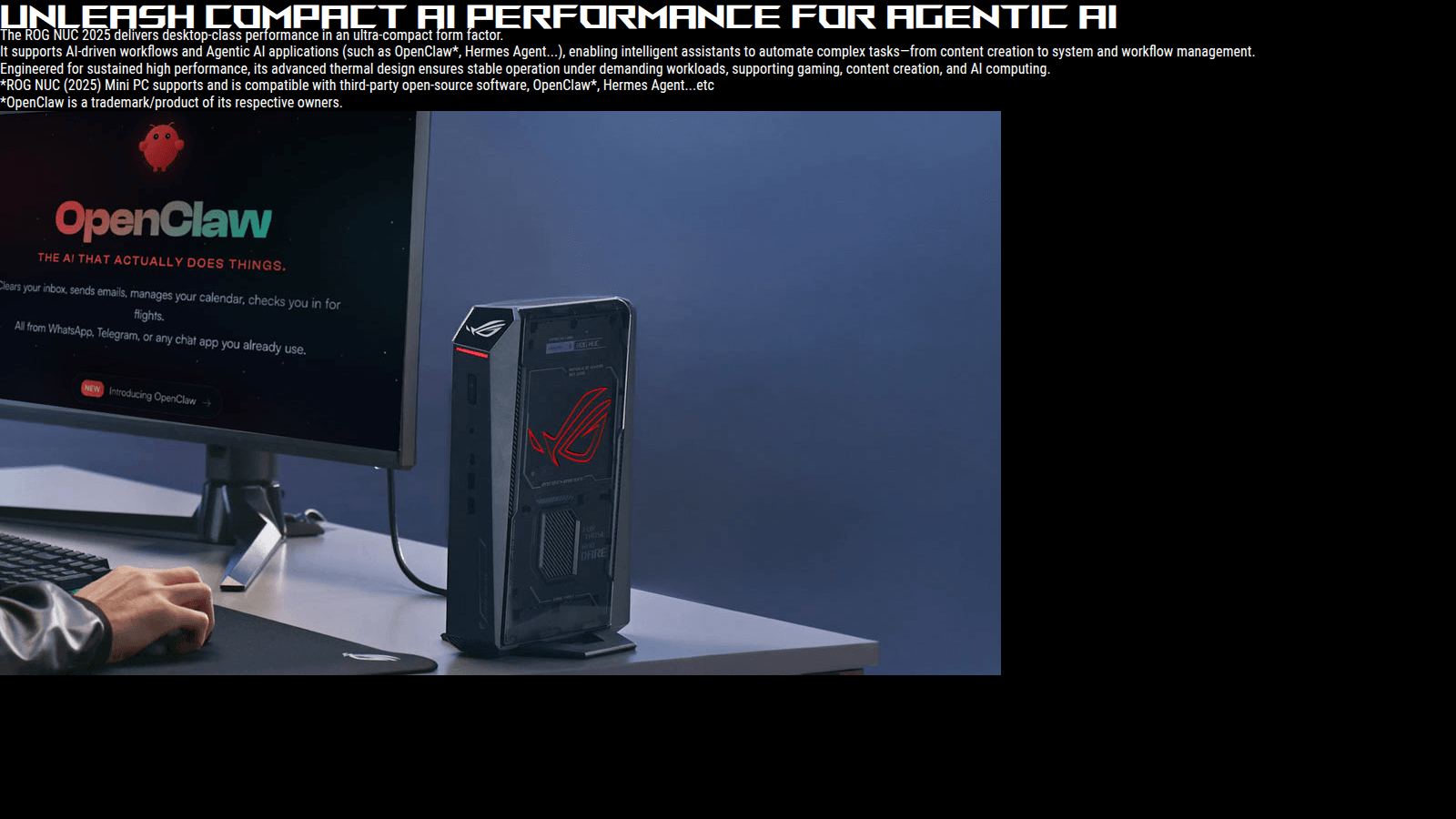
The official ROG NUC 16 product page lists configurations up to an Intel Core Ultra 9 290HX Plus processor and NVIDIA GeForce RTX 5080 Laptop GPU, with support for up to 128GB of DDR5 memory. ASUS also highlights a triple-fan cooling system and positions the machine for local inference and AI-agent workloads.
The earlier ROG NUC (2025) is a compact 3-litre system with configurations up to an Intel Core Ultra 9 275HX and GeForce RTX 5080 Laptop GPU. Its product page includes an “Agentic AI” section and describes a unified vapour chamber with triple-fan cooling.
Actual local-model capacity and performance will depend on the selected GPU, available memory, model precision, context length and software stack. ASUS’s official pages do not substantiate the submission’s exact “32GB and RTX 5080” pairing as a single named configuration, so that claim is not repeated here.
Ascent GX10 targets more specialised local AI work
ASUS separately describes the Ascent GX10 as a “Compact Agent Computer”. Its positioning focuses on local agentic-AI execution, continuous operation, private data handling and reducing dependence on external APIs.
ASUS explicitly qualifies its token-saving claim: results depend on the workload and model. Local processing still carries hardware, power, maintenance and administration costs, while organisations also need to account for security controls, model updates and data governance.
Data control is a benefit, not an automatic guarantee
Keeping a workload on-premise can give an organisation more direct control over files, vector databases and model access. It may also help where sensitive data should not be sent to an external provider.
Local deployment does not by itself create “absolute data sovereignty” or eliminate latency, reliability and security risks. Those outcomes depend on system architecture, software configuration, user permissions, network exposure, backups and operational practices.
What ASUS has and has not announced
The Agent Computer campaign establishes ASUS’s direction around local, hybrid and cloud AI, and the company has hardware that it associates with those workloads. It is not a single product launch with one specification, price or availability date.
The source submission came from an unaffiliated Gmail address and did not establish that it was issued by ASUS. This article therefore relies on ASUS’s official campaign and product pages for factual claims, while treating the submitted document as an editorial lead rather than an official press release.
Source: ASUS Agent Computer campaign, official ROG NUC 16, ROG NUC (2025) and ASUS Ascent GX10 product pages, reviewed 21 October 2026. TTR has not independently benchmarked these systems or verified the submitted cost model.