

Arm has publicly congratulated Xiaomi and Apple following the launch of their latest processors, using the two announcements to highlight the breadth of computing platforms built on its architecture.
In a post about Xiaomi’s XRING O3, Arm pointed to SME2 acceleration in the chip’s Arm CPU and an upcoming Mali GPU, saying the combination is intended to advance AI, general compute and graphics performance in Xiaomi’s next generation of devices. The comments were captured in screenshots published by IT Home.
XRING O3 targets flagship mobile computing
Xiaomi positions XRING O3 as a flagship system-on-chip. According to the company figures relayed in the report, its CPU uses a ten-core design comprising six higher-performance cores and four additional large cores, with frequencies reaching 4.35GHz. Xiaomi also claims a 60% performance uplift and says multi-core benchmark scores have passed 15,000.
The graphics subsystem is described as a 16-core G2-Ultra NX GPU with third-generation ray tracing. Xiaomi claims an 85% performance gain alongside a 64% reduction in power consumption. Those figures are vendor claims tied to Xiaomi’s test conditions and should not be treated as independent cross-platform comparisons.
Arm’s reference to SME2 is notable because the Scalable Matrix Extension is designed to accelerate matrix-heavy workloads, including machine-learning operations. Its mention of an “upcoming” Mali GPU also leaves some implementation details open; the post does not provide a complete architectural breakdown of XRING O3.
Apple’s M6 and M5 Ultra extend Arm on the desktop
Arm separately congratulated Apple on the M6 and M5 Ultra, describing the chips as significant advances in AI computing and performance. Both processors use Arm’s instruction-set architecture, although Apple develops its own CPU cores and broader system architecture.
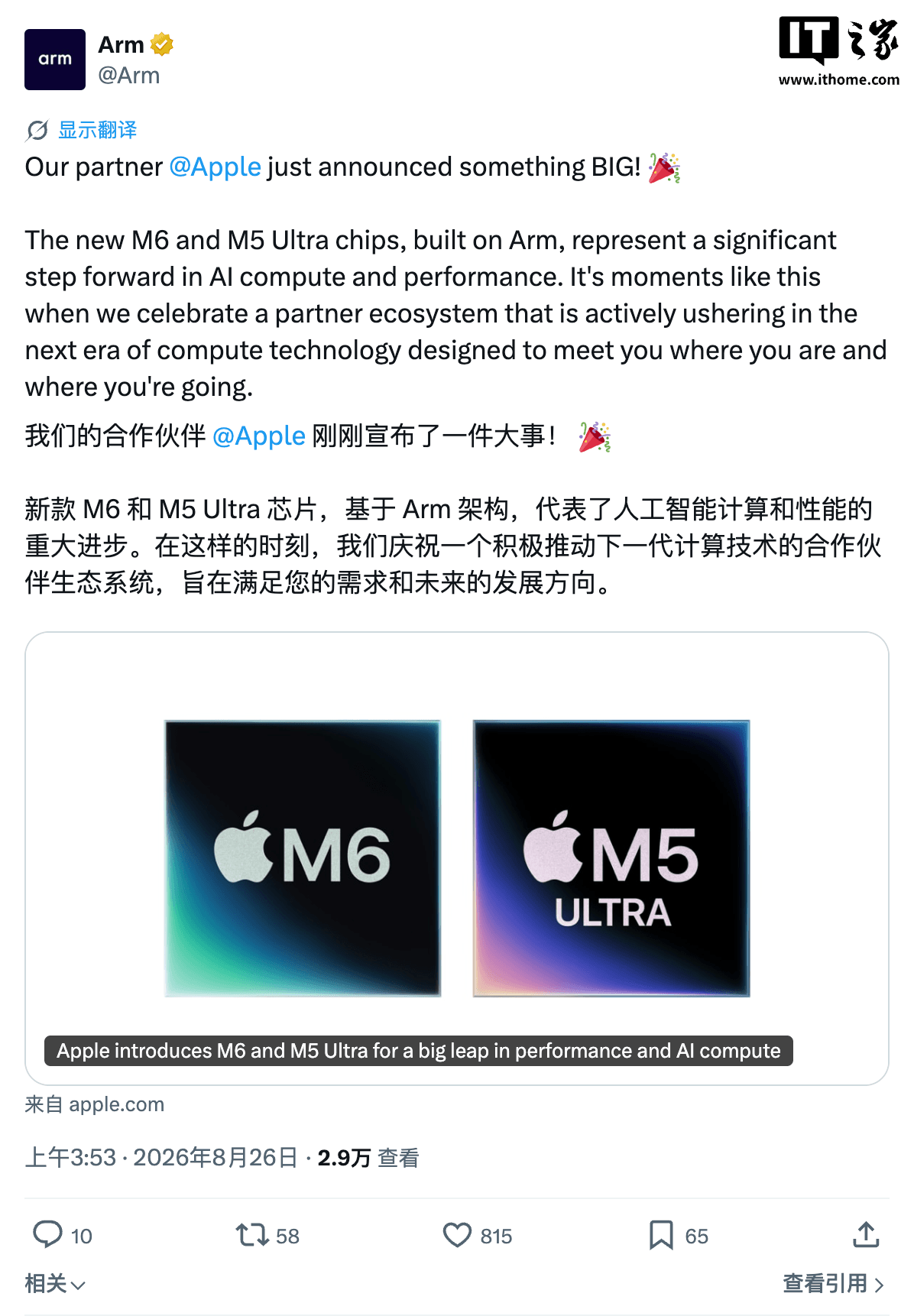
Apple’s official announcement says M6 is its first chip produced on a 2-nanometre process. It contains a 12-core CPU, 12-core GPU with Neural Accelerators, a dual 16-core Neural Engine and up to 170GB/s of unified-memory bandwidth.
M5 Ultra takes a different approach for high-end desktop workloads. Apple combines two dual-die M5 Max packages through its next-generation UltraFusion interconnect to create a four-die design. Configurations extend to a 36-core CPU, an 80-core GPU and 1.2TB/s of unified-memory bandwidth, with up to 512GB of unified memory.
Apple introduced M6 in the new Mac mini and M5 Ultra in Mac Studio. As with Xiaomi’s performance figures, Apple’s comparative claims use its own test configurations, so direct conclusions about real-world performance will require independent benchmarks.
One architecture, increasingly specialised implementations
Arm’s two congratulatory posts are less a joint product announcement than a snapshot of the company’s ecosystem. Xiaomi is emphasising a vertically integrated mobile SoC, while Apple continues to scale its custom Arm-based designs across consumer desktops and professional workstations.
The common architecture does not make the processors directly comparable. Their target devices, software stacks, memory systems and power envelopes differ substantially. What the posts do show is Arm’s continuing presence across both smartphone silicon and some of the industry’s most highly integrated desktop processors.
Sources: IT Home and Apple Newsroom.