China’s Ministry of Industry and Information Technology (MIIT) says HarmonyOS has become the world’s third-largest mobile operating system, while the broader OpenHarmony ecosystem has surpassed 1.35 billion cumulative devices.
The statement was made by Liu Yulin, director-general of MIIT’s Information and Communications Development Department, during a State Council Information Office briefing on 26 August 2026. It was reported by IT Home as part of a wider update on China’s software industry.
An official ranking, without a published measurement
MIIT described HarmonyOS as the world’s third-largest mobile operating system. The ministry did not, however, provide a market-share percentage, shipment count, active-user figure or research methodology alongside that ranking.
That distinction matters. “Third-largest” can refer to different measurements, including installed base, active devices, shipments or sales, and results can vary by geography and by whether different HarmonyOS generations are counted together. The claim should therefore be understood as MIIT’s official characterisation rather than an independently verified global market-share ranking.
MIIT has used similar language previously. In a review of China’s 2024 digital-industry developments, the ministry described the native HarmonyOS platform as the third major mobile operating system after Android and iOS.
OpenHarmony reaches 1.35 billion ecosystem devices
Separately, MIIT said cumulative devices in the OpenHarmony ecosystem have exceeded 1.35 billion. This figure is broader than the number of Huawei smartphones running HarmonyOS.
OpenHarmony is an open-source operating-system project hosted by the OpenAtom Foundation. Its ecosystem covers multiple device categories, including phones, computers, vehicles, home appliances and specialised industrial equipment. MIIT highlighted industry-oriented distributions used in sectors such as automotive, home appliances, metallurgy and petrochemicals.
An earlier MIIT briefing on China’s software sector likewise placed the OpenHarmony ecosystem above 1.35 billion devices and said the platform had expanded across phones, PCs, cars and appliances. Because the number is cumulative and spans many hardware types, it should not be read as a smartphone installed-base or active-user total.
HarmonyOS 6 adoption is a separate metric
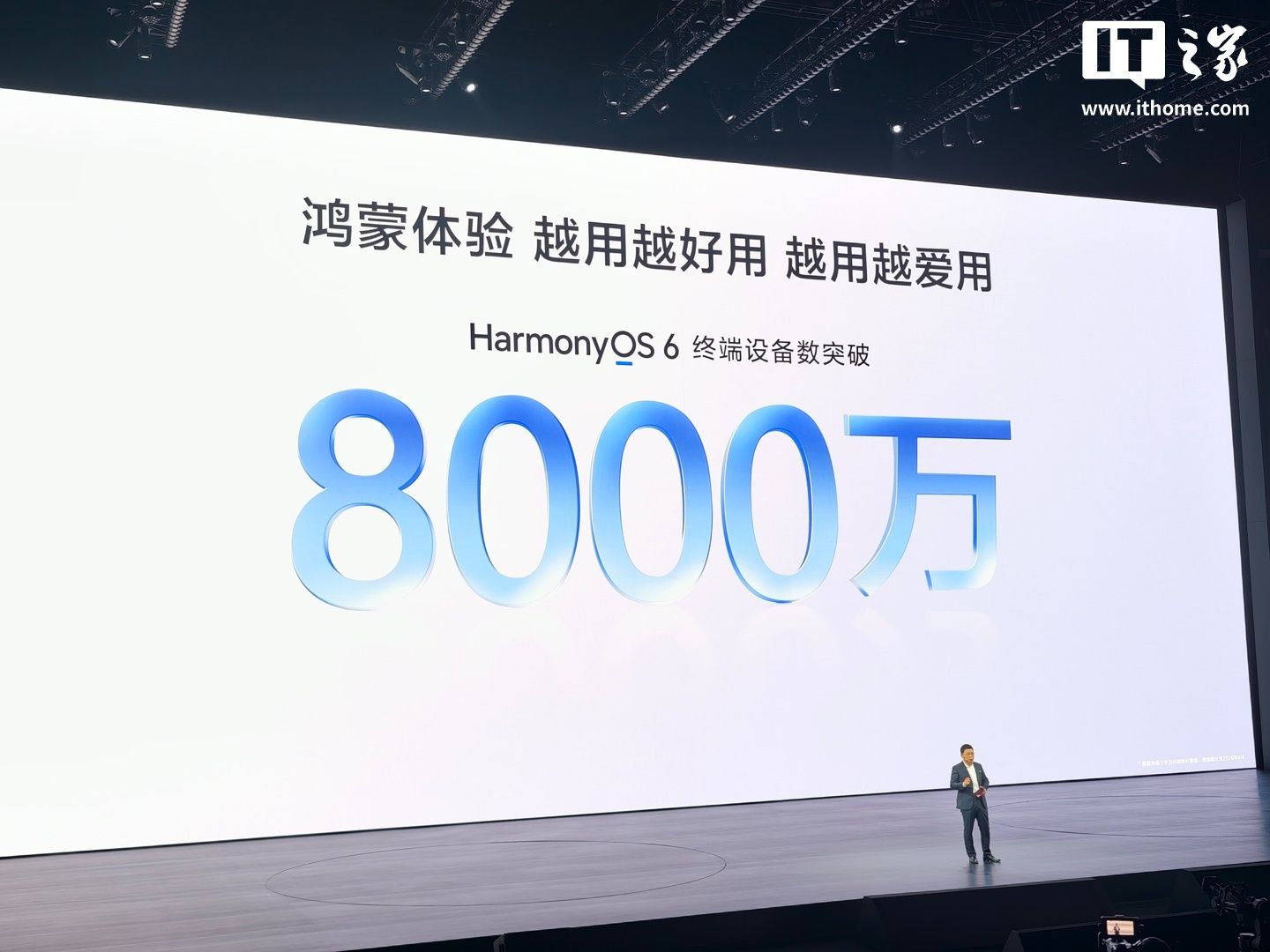
The report also cited Huawei consumer-business chairman Richard Yu as saying on 20 August that the number of devices running HarmonyOS 6 had passed 80 million. That product-version milestone is distinct from MIIT’s much larger OpenHarmony ecosystem figure.
The two numbers track different layers of the ecosystem: HarmonyOS 6 adoption refers to devices using a specific Huawei operating-system release, while the 1.35-billion figure covers cumulative devices across the wider OpenHarmony-based ecosystem.
MIIT presented the figures as evidence of progress in China’s foundational and industrial software sectors. The ministry also said domestic software products had advanced in areas including databases, three-dimensional CAD and modelling and simulation, while OpenHarmony-based systems were moving into large-scale industry deployments.
Sources: IT Home; MIIT software-sector briefing; MIIT 2024 digital-industry review.